

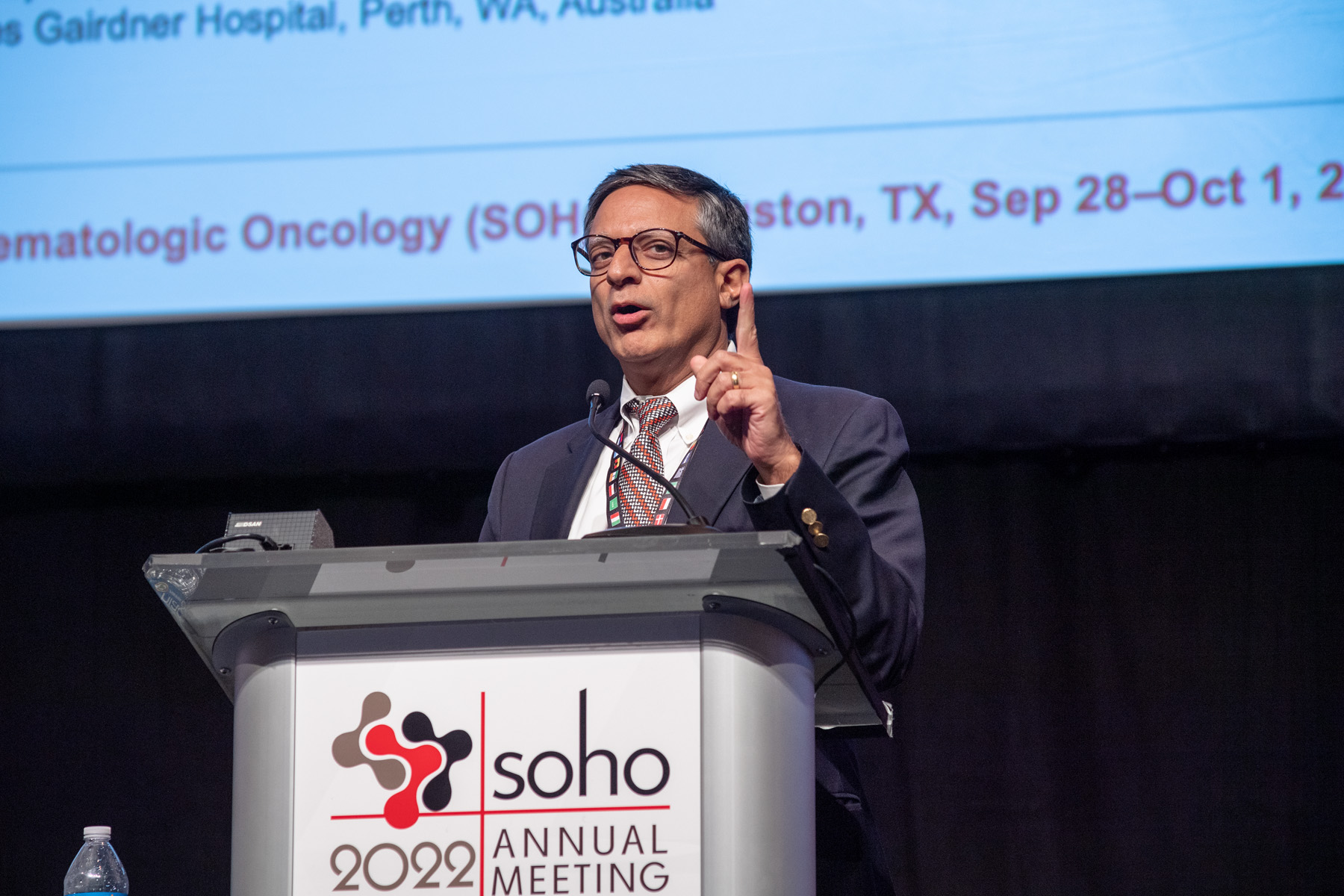
Sagar Lonial, MD, FACP, FASCO, has been described in many ways: an innovator on the forefront of myeloma drug development, a master at designing clinical trials, a builder of high-performing teams, and a mentor to countless clinicians.
One of SOHO’s most dedicated and longest-standing members, Dr. Lonial chairs the Education Committee, serves as Treasurer, and is editor in chief of the society’s news publication, SOHO Insider. Today, he will receive the Emil J. Freireich Distinguished Pioneer Award.
Few embody the spirit of the award more than Dr. Lonial.
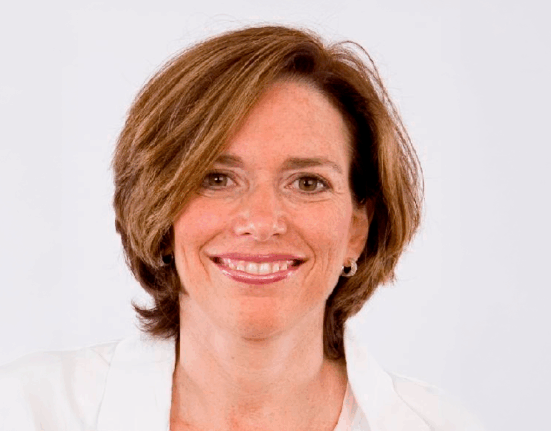
“Dr. Lonial has played a pivotal role in supporting and leading the society,” said SOHO’s Executive Director Janet M. Cesak, MBA, BS. “We are proud to honor Dr. Lonial for his innovative leadership and for his commitment to improving outcomes in all blood cancers through research, clinical trials, and mentorship.”
As Cesak recounted, it was Dr. Freireich himself who identified Dr. Lonial as “THE guy” to lead the Education Committee, the group of physician-scientists responsible for shaping the scientific content of the annual meeting.
Visionary leadership
Dr. Lonial is the chief medical officer of Winship Cancer Institute of Emory University, professor and chair of the Department of Hematology and Medical Oncology and the Anne and Bernard Gray Family Chair in Cancer at Emory University School of Medicine. He has spent his career pioneering how multiple myeloma is understood and treated across the world.
He has led or co-led many of the most important phase 3 clinical trials in myeloma, including studies that led to the approval of the first BCMA-targeted drug, the first anti-CD38 antibodies, and major advances in developing immunotherapies for the disease.
In addition to his research, he grew the myeloma program at Emory University from a two-physician clinic treating a few dozen patients a year into a team of more than 10 doctors treating more than 5,000 patients a year.
“Dr. Sagar Lonial’s visionary leadership, dedication to advancing multiple myeloma research, and tireless commitment to delivering the highest quality care have made an indelible impact, not only at Winship Cancer Institute of Emory University, but across the globe for patients with multiple myeloma,” Suresh S. Ramalingam, MD, FACP, FASCO, executive director of Winship Cancer Institute of Emory University, wrote in a statement to SOHO Insider. “Dr. Lonial’s work combines innovation with compassionate care and mentorship. On behalf of the entire Winship community, I offer my heartfelt congratulations and deep gratitude for all he continues to do to improve the lives of patients.”
It is all about the team
Despite the accolades, Dr. Lonial doesn’t see his work as an individual achievement.
“I don’t like the ‘me’ perspective,” he said. “Our group at Emory is critical to everything we’ve been able to do. I’ve just been lucky to be a part of it.”
When pressed on what others might see in his work, he pointed to his approach to designing thoughtful clinical trials, synthesizing complex data, and translating it into meaningful change for patients.
“What I’m known for is being thoughtful about how trial design can answer questions efficiently,” he said. “I try to synthesize the data to give the average physician insight into how and when to use something.”
Rather than simply listing study results, he said he aims to take “an approach that makes the most sense.”
That philosophy is evident in the breadth of his work, said Thomas G. Martin, MD, of the University of California Helen Diller Cancer Center.
“He’s been involved and a leader of many of the large phase 3 trials of our most important and most effective drugs in myeloma,” Dr. Martin said.
Dr. Martin rattled off the many therapeutics Dr. Lonial has been integral in bringing to patients, including “BCMA-targeted ADCs, bispecific antibodies, CAR T-cell therapies, and CD38 antibodies.”
Dr. Lonial’s early work centered on finding more effective treatments for high-risk patients and tailoring myeloma therapy to an individual’s risk level. In 2013, he and his team at Emory published data showing that standard maintenance therapy was not enough for high-risk patients and proposed a more intensive, individualized approach.
“That helped change the natural history of outcomes for high-risk patients,” he said. “What you do in maintenance for standard risk is probably not the same as what you want to do for a high-risk patient.”
That same drive to challenge convention shaped his work in smoldering myeloma. He led the ECOG E3A06 trial, the first large, randomized trial in the United States to show that early intervention could delay progression to symptomatic disease.
The trial enrolled more than 180 patients and compared continuous lenalidomide therapy to observation, finding significantly longer progression-free survival in those who received the therapy. The results were published in the Journal of Clinical Oncology in 2019.
“Once you demonstrate that early intervention can change outcomes, you open the door to a whole new set of research questions,” Dr. Lonial said.
His work at Emory built on that momentum. He and his colleagues created a standardized treatment model that has produced large, uniform datasets, including the decade-long RVD1000 series that followed 1,000 consecutively treated patients.
RVD is short for the triplet combination of lenalidomide, bortezomib, and dexamethasone, which is considered the standard-of-care induction therapy in newly diagnosed multiple myeloma.
The RVD1000 trial holds a special place in Dr. Lonial’s career, according to Dr. Martin.
“His favorite trial, I’m going to go on record saying, is the RVD1000,” Dr. Martin said. “Many of us in the myeloma space, every time he says it, we have to salute him for his involvement.”
The Emory team has applied this standardized approach to other practice-changing studies, including those evaluating daratumumab in combination with RVD.
“Now I think of daratumumab-RVD, and we can show real-world evidence in terms of outcomes because, again, as a group we practice similarly,” said Dr. Lonial. “It gives us the chance to go back and look at genetic factors and predictors of good and bad outcomes overall.”
From Louisville, Kentucky, to building the program at Emory
Dr. Lonial grew up in Louisville, Kentucky, at a time when new discoveries in the science behind cancer and genetics inspired his budding interest in oncology as early as high school. After earning his medical degree from the University of Louisville School of Medicine and completing residencies at Baylor, he seized an opportunity to work in a leukemia lab at Johns Hopkins with Judy Karp and Phil Burke.
“They [Karp and Burke] were wonderful role models for me and really shaped my interest in hematology and translational work,” Dr. Lonial recalled.
As his main mentor in myeloma, Dr. Lonial identified Ken Anderson of the Dana-Farber Cancer Institute (DFCI) in Boston.
“Despite us never having worked together, he and his team in Boston were very supportive of me and our growing program at Emory 25 years ago,” Dr. Lonial said. “Ken, Paul, and Nikhil Munshi at DFCI helped us to get access to new trials, lab techniques, and really helped us to get on the map.”
Leaders from across the globe embraced the program’s growth, recognizing the unique perspective made possible by team-based care.
“Overall, the myeloma community is very supportive of new ideas and voices,” he said. “I feel fortunate to have colleagues and friends from France, Spain, Italy, the United Kingdom, the Netherlands, Germany—in addition to all my friends and colleagues in the United States.”
The future of myeloma treatment
Looking to the future of myeloma treatment, Dr. Lonial is especially excited about trispecific antibodies and second- and third-generation CAR T-cell therapies targeting new antigens, including GPRC5D and FCRH5.
“Myeloma is pretty smart,” he said. “If you hit just one target, it figures out a way around it. The trispecifics let us hit more than one at the same time. That helps reduce drug resistance and, hopefully, improve outcomes over time.”
The next wave of therapies may bring myeloma closer to becoming a curable illness, Lonial said.
“I really think we are positioned to potentially cure a larger proportion of patients than we are with our standard induction, transplant, and maintenance approach,” he said. “And to do that in a way that doesn’t require patients to be on treatment all the time.”
The new treatments come with periods of relief where patients can enjoy life without constant therapy. But he also offered a note of caution. Some in the field have started advocating for de-escalating therapy or treating patients less aggressively because patient survival rates have improved.
“What I worry about is clinicians applying the model of Hodgkin lymphoma to myeloma,” he said. “We don’t have 98% of patients cured. So, de-escalation is always a little risky. You want to make sure you’ve done the best you can for a patient before you start talking about that.”
His caution comes with a note of optimism. While myeloma treatment isn’t yet at the cure rates seen in Hodgkin lymphoma, advances in therapy are opening new possibilities. “It’s an exciting future,” he said. “We’ve got a lot of work to do, but the tools are finally here.”
The Emil J. Freireich Award recognizes SOHO members who have significantly advanced the mission of the society. Honorees are chosen annually by a committee of their peers. Named for one of the founding figures in modern hematology, the award honors a physician or scientist whose work has significantly changed the landscape of blood cancer treatment.
Other notable news
In June 2025, Dr. Lonial also received the 2025 Robert A. Kyle Lifetime Achievement Award, presented annually by the International Myeloma Foundation (IMF) to individuals who have made significant contributions to myeloma research.
“Dr. Kyle is such a giant in the myeloma field. To have my name associated with an award that honors his legacy is an incredible honor,” Dr. Lonial said. “I am proud of our team at Emory for doing important work to improve outcomes for myeloma patients and expand their treatment options.”
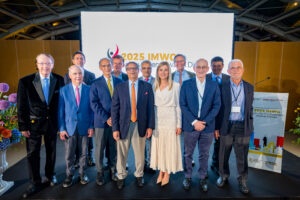
The award was a “recognition of Dr. Lonial’s immense and significant life-long contributions to myeloma treatment and research, including the development of several new drugs for the disease,” said IMF Chairperson of the Board S. Vincent Rajkumar, MD. “He also built a world-class myeloma program at the Winship Cancer Institute in Atlanta, and in the process has mentored numerous scientists in the field. I am also confident that under his leadership in the field, the myeloma community can be assured that the pursuit of a cure for myeloma is of the highest priority.”
In 2024, International Myeloma Society awarded Dr. Lonial the Bart Barlogie Clinical Investigator Award for contributions to multiple myeloma research.
“This award is an outstanding recognition of the contributions of the Winship myeloma team to our field,” Dr. Lonial said in a 2024 Emory press release. “I am honored to be recognized in the name of Dr. Barlogie, who made so many seminal contributions to patient care and research in myeloma.”
Visit the SOHO 2025 meeting news page for more coverage from the meeting.
Leave feedback about this