
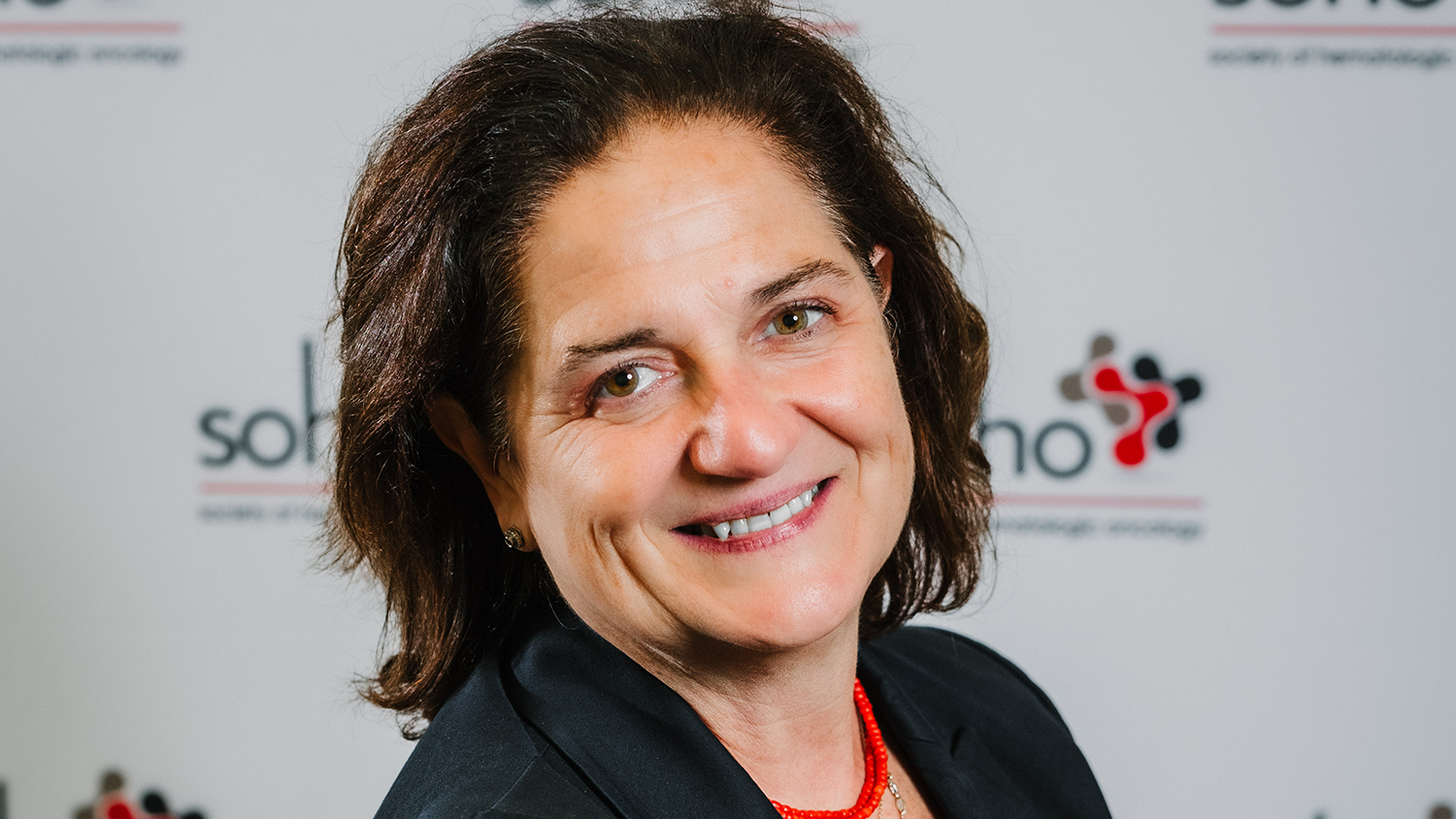
2026 SOHO President-elect Valeria Santini, MD, grew up in Florence, where she says the city’s beauty, history, and art shaped her entire outlook on life. “My garden borders the medieval city walls,” she says. “When I open my window, I see a medieval tower and a beautiful park. You feel that it belongs to you, it’s part of you, and that beauty shapes your whole life.”
What was your career path to medicine?
My family moved to Florence when I was six years old, and that’s where I attended primary school, high school, and university. At the time of choosing my field, I was very uncertain. Growing up in Florence, I was drawn to philosophy or art history, but I decided to pursue something more scientific and humanity-focused, so I chose medicine.
Very early, in my second year of medical school, I asked to join a general pathology lab. I was studying for my regular exams but also doing a lot of lab work, and I just grew up with this combination of study and research.
After university, I moved to the Netherlands for three years during my post-graduation period, working in a lab on translational studies in acute myeloid leukemia under Professor Bob Levenberg.
After that, I returned to Italy, to the University of Florence, where I completed my post-graduate training. There, I became first an assistant professor and then an associate professor.
What first drew you to leukemia and MDS?
It started very early, during university. I was studying murine leukemias and murine erythroleukemias, and the biology was fascinating. Later, I met my mentor, who was a clinician, and I moved from experimental work to the clinic, but kept my interest in translational studies. The lectures we had were full of empathy and science; I knew I had to become a hematologist.
How has hematology changed since you began practicing?
When I started, there were very few treatment options. In chronic myeloid leukemia there were no active treatments yet; for AML, only a few; and for MDS, absolutely nothing — only the youngest could receive chemotherapy. Early on, I was very interested in CML, even before imatinib. I remember as a fellow, it was a nightmare to diagnosis CML. The hospital itself was different: less efficient, no ward chambers, and the conditions were basic.
Eventually, I became interested in CML and AML, which led me to spend time in Houston at MD Anderson. It was a beautiful and inspiring period. I was exposed to new drugs and an entirely new approach to disease. MD Anderson is different from anywhere else. The level of treatment, the organization, and the opportunity to work alongside so many skilled hematologists taught me so much.
What made you shift from AML to MDS, and what challenges do you see in treating MDS?
I moved to MDS because I thought the two diseases were similar and MDS somehow more challenging. In fact, MDS and AML are completely different diseases, with different biology; only some aspects overlap.
Many studies for high-risk MDS were designed in a similar way to the ones we have for AML, with the same endpoints, and sometimes that is really not the case. Another big problem is that several studies carried out recently for high-risk MDS have failed. This was partially because the study design was not strong and also because the treatment was not supported by strong biology. It was just empiric: you use a drug because you think it may work or it worked in another disease, but then it’s not applicable to MDS.
MDS is also very heterogeneous. If you treat high-risk patients the same way, maybe you miss the subgroup that could respond to some agents more than to others. It is a big problem in treating this disease. Now the hopes and hypes are frustrating. We are left with only azacitidine or decitabine that have been used for a very long time. Only a few cases have the possibility of targeted therapy because of specific mutations, like IDH1 with ivosidenib or IDH2 with enasidenib. Let’s say these are very rare cases for MDS; for the rest, unfortunately, it’s a big problem.
With international collaboration, digital tools, and AI now aiding drug discovery, do you feel more hopeful about the future of MDS treatment?
Absolutely. What I think is important and will hopefully lead to solutions in our high-risk MDS fight is the fact that AI can help us put together the mechanisms of action that have been clarified in translational studies, agents that are available, and also define better MDS biological subgroups. MDS has been divided and stratified by mutations, type of mutations, cytopenias, and cytogenetics. There is so much heterogeneity that it is important to focus on all subgroups instead of just treating everybody in the same way.
Many studies for high-risk MDS were designed in a similar way to the ones we have for AML, with the same endpoints, and sometimes that is really not the case. Another big problem is that several studies carried out recently for high-risk MDS have failed. This was partially because the study design was not strong and also because the treatment was not supported by strong biology.
Has there been progress with consolidating the WHO and ICC classifications?
The WHO and ICC classifications are not so different, but there are some points that indeed differ. One major difference is related to the blast count and definition of MDS vs AML/MDS, which in my view is not so crucial. Yes, there is progress. We are working very intensely to reach the final merging of the two groups and categories. Each group has raised issues—very important ones, actually, but this also highlights the heterogeneity and the difficulties in stratifying, classifying, and diagnosing MDS. It’s a challenge, and I like it. It’s very important.
It is becoming quite clear that blasts are not the problem and that what is called the continuum between MDS and AML is not always to be considered a continuum. They are two different diseases biologically. Some subtypes overlap, like the ones with TP53 mutations. These represent a separate category that brings together MDS and AML.
Will merging the WHO and ICC classifications immediately affect patients, or is it mainly an academic exercise?
Yes, it depends on which kind of classification you choose. A person who has acute leukemia might previously have been classified as high-risk MDS. In this sense, it may affect the patients, but only in this aspect. Otherwise, patients have their diagnosis, but they want to know their prognosis and risk.
Today, I saw a lot of patients. They asked me, “How long do I have to live? Is my life expectancy different from others my age? Will I develop a bad disease?” This is something they indeed ask for and we should be able to reply without being too pessimistic or too lighthearted.
How long have you been involved with the society?
I have been involved with SOHO since the beginning and have witnessed the incredible growth of the meeting. We started small, then it grew bigger, and now it’s a huge event with many enthusiastic participants. The friendly atmosphere of the annual meeting has become a defining feature of the meeting; there’s real exchange and opportunity for discussion. Every September, during this special month, we come together for this remarkable encounter.
I’ve been part of the Education Committee for many years, which has been a rewarding experience, and I’ve also frequently served on the faculty. I also learn a lot by attending sessions beyond my usual focus on MDS or AML.
You were elected to be the 2027 president of SOHO. How do you feel about taking over the presidency?
I’m quite emotional about this presidency. I’m very excited and a bit nervous because I hope to be a good president and create a strong program and agenda for the meeting. SOHO is more than a meeting, it’s an experience. The level of science, medicine, and educational energy is outstanding.
I’m incredibly honored to become president-elect. It’s truly amazing, especially as someone not based in the U.S., because it makes the role even more meaningful. SOHO’s educational mission is global, reaching many countries through the Ambassador Program, which spreads learning and updates to hematologists worldwide, including those from developing countries who might not otherwise have access to this kind of education.
The Young Investigator Program scholarship is also unique. It has brought so many young investigators and hematologists to Houston who have been charmed by the atmosphere. I hope to continue that spirit. People come to listen and learn from the best experts in hematology.
How did growing up in Florence, surrounded by Italy’s rich culture, inform you as a person?
Italy is a special place. Everywhere you go, even in a small town, you find amazing history and art. We are surrounded by beauty. My garden borders the medieval city walls. When I open my door or window, I see a medieval tower and a beautiful park. You feel that it belongs to you, that it’s part of you, and that beauty shapes your entire life. Because you see beauty from morning to night, from the time you are a child, you get used to it, but at the same time, it educates your eyes and your way of thinking.
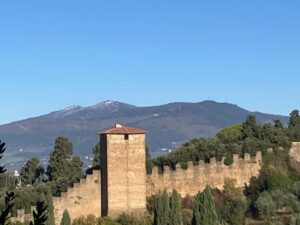
I don’t have much time for hobbies, but I go to museums, or I take walks in the hills around Florence and discover incredible places. Recently, I took a walk near my home and met a guide who brought me to an abandoned church. He showed me the landscape and asked, “Do you recognize it?” It was the background from one of Leonardo’s most famous paintings. This is the kind of experience you can have here, and I hope everyone who visits can understand and appreciate a little of this magic.
I also proudly belong to the Accademia delle Arti del Disegno, an academy founded in 1563 for art and design. It’s an academy that brings together science, but mostly artists, writers, musicians, and sculptors. It’s still active and lively after 450 years.
My inspiring, impossible companion for a special dinner is Matilde di Canossa. She was an incredible, strong and powerful woman who was born in 1046. She established the basis for the greatness of Florence, among other many political actions. I would like to hear her voice and ask how she could be so resilient, build her own fascinating personality in the middle-age era, surely difficult for independent women.
Valeria Santini, MD, is an associate professor of hematology at the University of Florence Medical School in Italy. She is SOHO president-elect and assumes the role of presidency in 2027.