

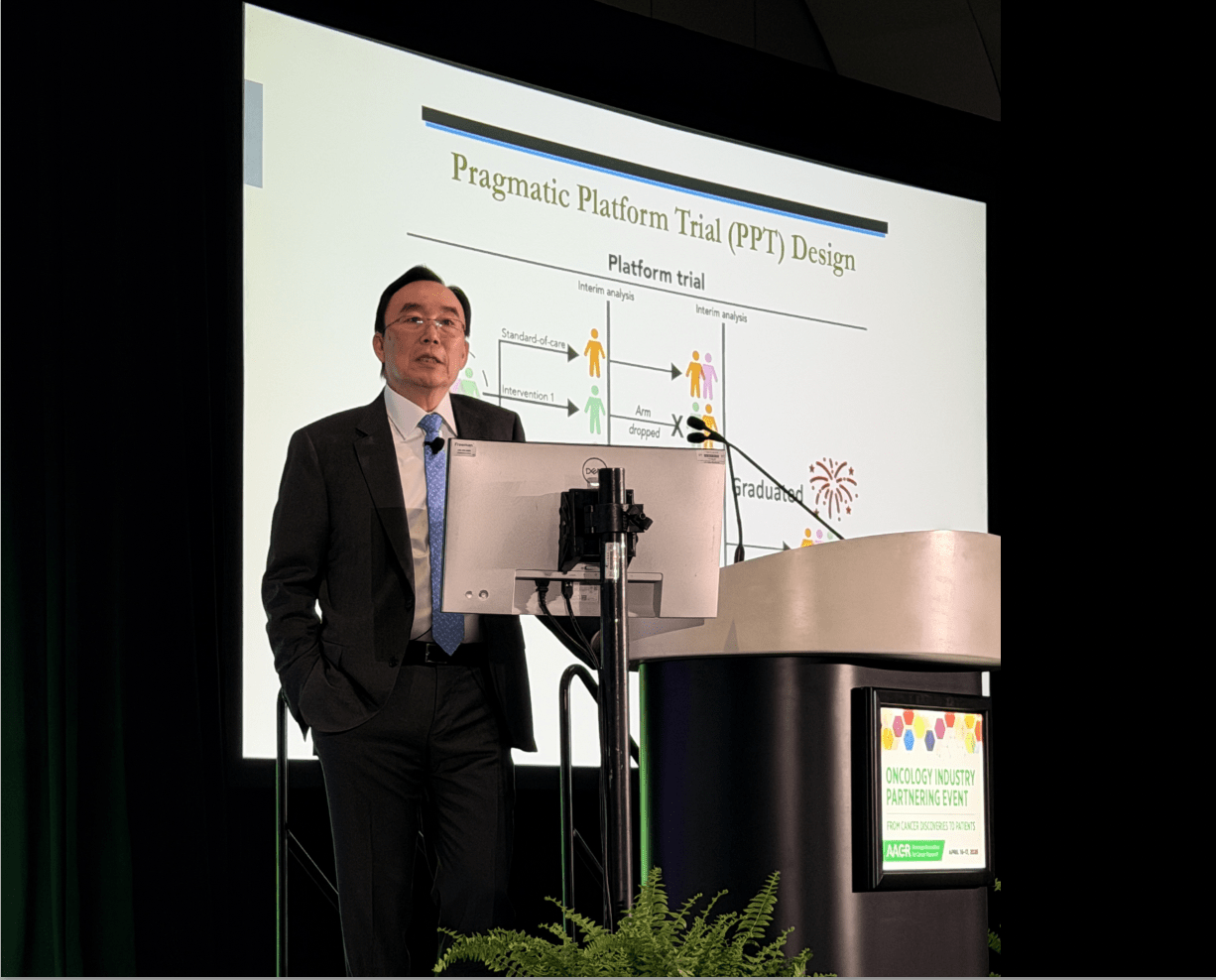
SAN DIEGO—Human intelligence will be more important than ever as artificial intelligence continues to proliferate throughout clinical care, according Yu Shyr, PhD, FAACR, chair of the Department of Biostatistics at Vanderbilt University Medical Center in Tennessee. Dr. Shyr was the keynote speaker at the AACR Oncology Industry Partnering Event, which is being held April 16–17 in San Diego.
The growing use of AI in clinical care comes as more than 1,000 FDA-authorized tools have entered use, largely without evidence from randomized trials, Dr. Shyr explained to an audience of industry experts, investors, and healthcare professionals.
He stressed that AI should change how clinical trials are designed and interpreted, but must ultimately demonstrate real clinical value. Dr. Shyr pointed to a gap between the strength of evidence generated in controlled settings and how treatments perform in practice, where patient populations and care delivery are far less uniform.
“We ask the question, does it work in real-world practice,” Dr. Shyr said, pointing to pragmatic clinical trial designs that are embedded in routine care and reflect how patients are actually treated.
That distinction between controlled and real-world settings also shapes how trial results are interpreted, Dr. Shyr noted, since even so-called negative trial results may still contain meaningful signals at the individual level.
In one example he provided, an ICU oxygen study published in the New England Journal of Medicine showed no overall difference between treatment strategies, but patients appeared to respond differently. A subsequent machine learning analysis identified distinct groups who benefited from different approaches.
“ML-derived individualized treatment effects from RCTs can change practice,” Dr. Shyr said, noting that one such model has been incorporated into the EHR system Epic to support ICU decision-making.
He also said the focus of those learning new AI tools should shift from coding to understanding. “We need to spend more time [focused] on knowledge and learning,” Shyr said, noting that students “need to understand [what] is the right method… and when [AI] is incorrect.”






Leave feedback about this