

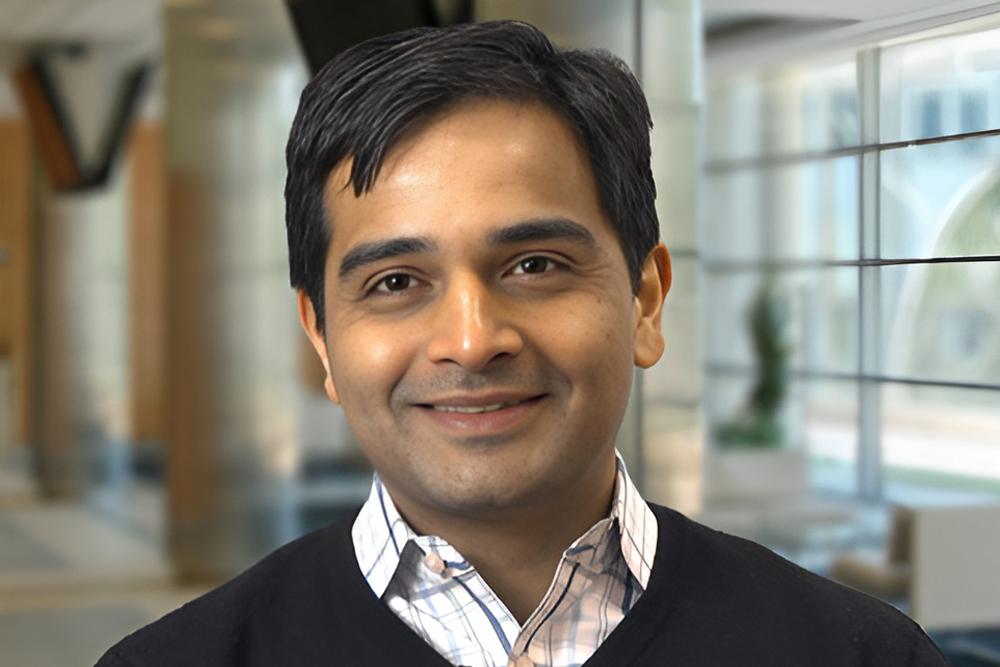
Meet Naval Daver, MD, a professor and director of the Leukemia Molecular Laboratory in the Department of Leukemia at the University of Texas MD Anderson Cancer Center, talks the future of AML and gives some advice to early-career clinicians.
“Even if we cannot guarantee a cure, patients appreciate that we are trying our best and see MD Anderson and our team as a place of hope. That’s the number one thing we can offer.”
This interview has been edited for length and clarity.
When did you become interested in pursuing medicine as a career path? Both my parents are well-known physicians in India. My dad is a cardiothoracic surgeon, and my mom is an OB-GYN. They were both deans of large medical schools, so I was always exposed to medicine, and from a young age it created an interest for me.
My dad trained in the United States with Michael DeBakey in 1986 for three years, so we all lived in the United States at that time. He had very fond memories and still had friends in Houston when I was applying for residency. He was eager for me to get exposure to the US medical system, which is very advanced in terms of technology, clinical trials, and access to medications. That led me to Baylor College of Medicine for my internal medicine residency. I stayed on at Baylor for my hematology-oncology fellowship and eventually joined MD Anderson as an assistant professor in 2011.
Why did you choose AML as a specialty? When I was a fellow at Baylor, I was interested in both hematologic malignancies and infectious disease. Those were the two broad areas, more from a clinical and treating physician perspective. During my fellowship, I rounded at MD Anderson and learned more about clinical research and the global impact that clinical trials and drug approvals can have beyond what you can do seeing 20–35 patients a day. You can impact hundreds or thousands of patients on a weekly basis, many of whom you will not see, but who will still have access to and benefit from these treatments.
Around 2011, when I was doing my fellowship and rounding at MD Anderson, we started to see the emergence of new targeted therapies and the potential for immunotherapies. I felt this would be an area where we could make a lot of progress over the next two to three decades. There was a lot to be done. AML was a disease with a huge unmet need for almost 40 years, which is why I became more interested in AML and in clinical trials.
Is AML moving toward mostly targeted therapies, or is there still a meaningful role for traditional treatment? In AML, we’re probably 10 to 15 years behind ALL and maybe myeloma. I often use myeloma as an example because the trajectory of drug development we’re seeing in AML is very similar. We now have targeted therapies that have clearly made inroads. FLT3 inhibitors, IDH1, IDH2, and now menin inhibitors can target about 50% to 55% of patients with one or more of these aberrations. Most of the survival improvements we’ve seen in the past 10 to 15 years have come from these targeted therapies, not as single agents, but when moved into the frontline setting in combination with traditional intensive chemotherapy or lower-intensity therapies.
What we are still missing in AML is a very effective immunotherapy. In ALL, bispecific antibodies, antibody-drug conjugates, and CAR T-cells have really accelerated progress and improved cure rates. There is a lot of effort underway in AML, and I think in the next four to five years we’ll see the emergence of new antibody-drug conjugates and potentially cellular therapies, whether natural killer cells or CAR T-cells. That will lead to further progress.
Similar to myeloma, we are already using less frontline intensive chemotherapy and lower-intensity approaches, such as venetoclax with a hypomethylating agent, and then adding targeted therapies when available.
Over the next five to 10 years, I think intensive chemotherapy will be limited to a small subset of patients, maybe 25%, who are truly chemosensitive. For the rest, treatment will shift toward lower-intensity approaches, which would be a major change in how we treat AML.
What have you learned from your patients? I love interacting with patients; it’s what drew me to clinical practice rather than laboratory-based research. For us, the clinic is our laboratory. It’s where we learn, then apply that knowledge to our trials to improve outcomes for our patients.
I think the main thing we’ve learned is that we’re making progress—there’s no doubt. In newly diagnosed AML patients who are young and fit, cure rates are now close to 65%–70%, and even in older patients, we’re getting better.
There’s still a lot of unmet need, especially because the patients who come to MD Anderson tend to have difficult-to-treat disease like TP53-mutated disease or complex cytogenetics. That keeps us working to develop new treatments, because many patients still need better options.
Even if we cannot guarantee a cure, patients appreciate that we are trying our best and see MD Anderson and our team as a place of hope. That’s the number one thing we can offer.
What is your advice for early-career investigators? You have to have a mindset that failure is part of the pathway. It’s not realistic to expect the first few things you do will all be successful. One area I’m focusing on is TP53. It’s a difficult condition, and improving outcomes will take effort and many failures, but it only takes one success to improve outcomes for thousands of patients. We’ve run many trials: CD47 antibodies, APR, and now immune approaches like NK cells, CAR T-cells, and TP53-targeting inhibitors.
Even when a trial doesn’t meet a clear statistical endpoint, we learn about the immunobiology, the tumor microenvironment, and co-occurring features. When you design a trial, it’s important to build in strong correlatives and molecular and immune analyses. That knowledge will eventually lead to better treatments.
How is MRD used to guide care in AML, and where is it headed? MRD is probably going to become central in AML treatment as it already is in ALL and CML, for example. In AML, there has been a lot of challenges in implementing MRD over the last 10 years, mainly because of the type of MRD used, called multiparametric flow cytometry, which has a sensitivity of about 0.01%. This method has to be done in real time, usually within 24 hours, to be accurate, and it’s very dependent on the expertise of the operator reading it. Also, in general, it cannot reliably go below one in 100,000, and sometimes the sample quality isn’t high enough to support that level of sensitivity.
Now, we’re moving toward DNA-based molecular MRD assays, similar to what our colleagues in ALL have been doing with ClonoSEQ. We now have NGS-based MRD assays for FLT3 and NPM1, and hopefully soon an RNA-based MRD assay for KMT2A. This will cover about 50% of AML patients, and I do think we’re going to have very good NGS-based MRD assays. They can be done on stored DNA samples, are less dependent on operator expertise, and can usually be done centrally across clinical trials.
I think the FDA is open to these approaches, especially DNA-based MRD, for the future. In the coming years, we’re going to see more AML trials, using this as the primary endpoint, which could save five to eight years of survival follow-up and help get these therapies approved and out to patients faster.
This is an extensive area of research that we’re working on with many colleagues in the United States and internationally, and it will accelerate clinical trial development and approvals in AML.
What is one thing people would be surprised to know about you? I did martial arts for many years, and I’m a black belt in karate.
What hobbies do you enjoy? I love the outdoors, and when I travel with my family, we’ll go to places where we can either hike or ski. These are my favorite outdoor activities where I can shut my brain off for a few hours and focus more on physical activity and nature.
What is one thing that makes the clinical day better? For me, the most important thing is having good colleagues and friends. We spend a lot of time in the hospital, and at MD Anderson, I’m lucky to work closely with great colleagues. If you’re only coming to work, spending 10 hours, and leaving, it’s difficult. But having friends, joking, and talking about your weekend makes it a much more fun place to be.





Leave feedback about this