
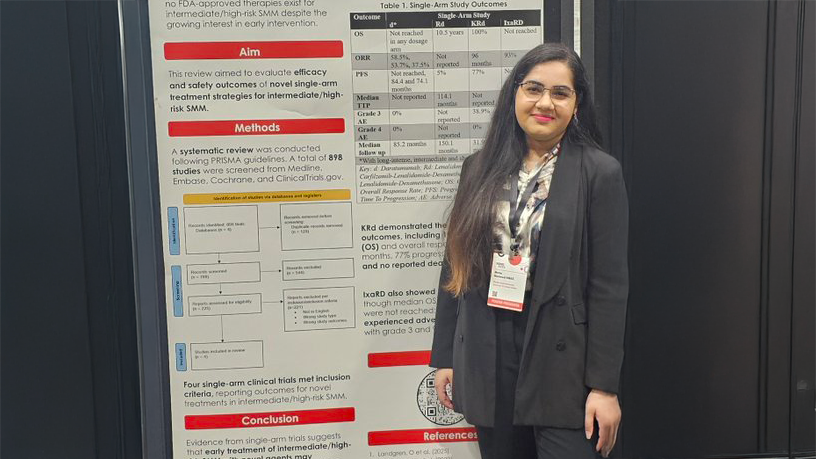
As a resident physician who is fascinated by hematologic malignancies, Maha Hameed, MD, brings a distinctive combination of scientific intrigue and personal drive to her work in hematologic oncology.
Now in her third year of internal medicine residency and serving as an assistant chief resident at Florida State University (FSU) Sarasota, Dr. Hameed is a 2025 recipient of the SOHO Young Investigator Program (YIP) Award.
“Myeloma immediately drew my interest from the acuity standpoint” she told SOHO Insider. “People say it’s like the critical care of heme-onc. Things are quickly evolving, they’re quick-paced, they’re dynamic, there’s a lot of things that you take care of the patient from an A-Z perspective, you’re not necessarily reliant on other specialists.”
At the 2025 SOHO Annual Meeting, Dr. Hameed was particularly struck by two myeloma-focused sessions. One was a presentation by Hans Lee, MD, on trispecific therapies, building on the recent progress in bispecific antibodies.
“I felt that was incredible … I was still trying to understand bispecifics… now we have trispecifics,” she said.
The other standout session, she said, was given by Sundar Jagannath, MD, on whether it is time to use the word “cure” in myeloma.
“You’re taught in [medical] school and residency, myeloma is incurable,” she said. “It was fascinating to hear someone make the case for rethinking that.”
She also spoke about the ongoing debate in the myeloma community between “cure” advocates and skeptics.
“Both sides definitely have very interesting points. I don’t think I’m there from a clinical perspective to give an opinion, but as a trainee, it’s interesting to see what’s still considered controversial; those are the things I want to pay attention to,” she said.
Dr. Hameed learned of the Young Investigator Program after first attending the SOHO meeting in 2024, where she presented a poster but wasn’t aware of the YIP opportunity. This year, she returned as a Young Investigator and presented two abstracts; one a systematic review of novel treatments for intermediate and high-risk smoldering myeloma, the other a retrospective study four patients with hemophagocytic lymphohistiocytosis (HLH) at Sarasota Memorial Hospital.
“The systematic review analyzed efficacy and safety outcomes from four single-arm clinical trials,” she explained. “We found that the KRD regimen (carfilzomib, lenalidomide, and dexamethasone) had the best outcomes, with a 100% overall response rate and minimal severe adverse events.”
She noted that it was especially interesting to see changes in clinical guidelines align with her research.
“It was about a week after SOHO that the International Myeloma Society decided to treat high-risk smoldering myeloma; that was exciting to witness,” she said.
Her second study carried personal significance. It focused on four patients with HLH treated at her institution, and one patient in particular stayed with her throughout the process.
“I remember very vividly when I presented the consent form to the patient’s wife,” she said. “She told me that the only reason she was signing it was because she knew I would do a good job. That stuck with me.”
From an early age, Dr. Hameed knew she wanted to go into medicine. Born in Houston but raised in Canada and Saudi Arabia, she attended medical school directly after high school in Saudi Arabia, where her interest in hematologic malignancies solidified.

“In tenth or eleventh grade, we learned about the concept of stem cells and how they differentiate into red blood cells, platelets, and so on,” she said. “One tiny change in that process can lead to different types of blood cancers. That fascination really drew me toward medicine.”
Growing up and studying in multiple countries—notably at an international school in Saudi Arabia, where she made friends with students from all over the Middle East—gave Dr. Hameed a versatile perspective that serves her well in clinical settings.
“All those interactions helped me keep a broad mind when it comes to adaptability and communication skills,” she said. “Arab culture is very different from growing up in the US or Canada. That teaches you to always think before you talk. I try to always consider someone’s background when I interact with them.”
Her mentors have also played a crucial role in her development, especially Faiz Anwer, MD, a hematologist-oncologist at the Cleveland Clinic, whom she has known since medical school.
“I’ve worked with him on many different research projects,” she said. “One that I presented last year at ASH was through his mentorship.”
She also met another mentor in person for the first time at SOHO 2025, after developing a long-distance mentorship through ASCO.
“He’s my career mentor… someone who takes a really personal level of interest in your development,” she said. “I know it’s going to be a long-term relationship.”
For all her scientific focus, Dr. Hameed values balance in her life. Now that she is further along in residency, she has more time to enjoy comedy shows and taking outdoor excursions.
“We have a sunset boat tour here in Sarasota that I enjoy at least once a month,” she said. “In the hospital, you’re go, go, go. It’s a great change of pace and helps me reset.”

As for her future, she is interviewing for hematology-oncology fellowship programs, exploring interests that range from cellular therapies and CAR-T research to bone marrow transplantation.
“The way oncology is developing, most clinicians end up specializing in one disease because there’s so much complexity,” she said. “Right now, my plan is to focus on myeloma, but I’m definitely open to areas like lymphoma or cellular therapies.”
When asked about emerging trends she finds exciting, she mentioned nanotechnology and its potential applications in medicine.
“There was an article about tiny chips that can deliver medicine and monitor doses inside the body,” she said. “I don’t have a biomedical background, but that kind of thing is fascinating to me.”
Maha Hameed, MD, is an PGY-3 internal medicine resident and assistant chief resident at Florida State University (FSU) Sarasota, and 2025 SOHO Young Investigator awardee.
The SOHO Young Investigator Program supports aspiring hematologic oncologists to attend the Annual Meeting in Houston and provides the opportunity to meet with leaders in the field. Read more about YIP here.
For more information on how to support SOHO and all of its programs go to soho.click/donate.