


The new circulating tumor DNA guideline from the American Society of Clinical Oncology sets a basic framework for testing in lymphoma, though it is short on details for this group of malignancies.
ASCO’s first guideline on ctDNA testing in solid tumors and lymphoma was published by Christina Lockwood, PhD, head of the Genetics and Solid Tumors Laboratory at the University of Washington Medical Center, and colleagues in the Journal of Clinical Oncology in June.
The guideline doesn’t include any commentary on lymphomas and there are no lymphoma studies listed in tables of meta-analyses in the JCO paper.
Lymphoma was included in the guideline with solid tumors because it typically presents as masses in lymph nodes or other tissues, explained hematopathologist and guideline co-author Rena Xian, MD, in an interview. And unlike

leukemia, it doesn’t typically present with circulating malignant cells, so disease has traditionally been evaluated and monitored with imaging studies, not blood tests.
Currently, the main way to evaluate treatment response in lymphoma and many solid tumors is with CT or PET/CT imaging, and ctDNA has potential to add to that information, especially in the post-treatment setting, to understand disease control, said Dr. Xian, who is associate professor of pathology and oncology at the Johns Hopkins University School of Medicine.
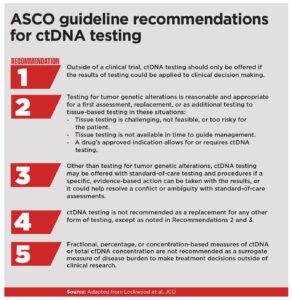
Among other key findings, a panel assembled by ASCO to create the guideline recommended ctDNA testing for genetic alterations in cases where tumor tissue testing is not possible.
“Clinical judgment is crucial in determining when tumor biopsy is too challenging to perform immediately, or is unfeasible, or presents a risk that is unacceptable to the clinician or the patient,” Lockwood and colleagues advised.
The guideline was released now in response to the “tremendous” increase of published data on ctDNA testing in recent years — yet with all of that information there are still many uncertainties and controversies about how to best use ctDNA in clinical practice, the authors explained.
To develop the guideline, ASCO assembled an expert panel that conducted a systematic review of literature published from January 2017 to February 2025, ultimately basing the guideline recommendations on 54 meta-analyses and 22 study reports. Seven randomized trials were included in the review. The panel included representatives of patients, community oncology, the College of American Pathologists and the Association for Molecular Pathology.
The panel also considered findings from a prior review of the literature on ctDNA testing by ASCO and CAP. Summarizing those findings in the JCO in 2018, Jason Merker, MD, PhD, and colleagues had flagged the lack of evidence for “the majority of ctDNA assays in advanced cancer.”
“There is no evidence of clinical utility and little evidence of clinical validity of ctDNA assays in early-stage cancer, treatment monitoring, or residual disease detection,” the review authors concluded in 2018.
The fact that ASCO as an organization is now saying ctDNA can be used as the first assessment or replacement when tissue testing is not available, though with caveats, is a big change from that prior assessment, Dr. Xian noted.
The field has evolved and the ability to analyze hundreds of genes from a blood sample has fueled growing interest in ctDNA testing among patients and oncologists and created a need for a guideline to streamline practice, commented Apostolia Tsimberidou, MD, an expert oncologist at the University of Texas MD Anderson Cancer Center and a panelist for both reviews.

“On one hand, we want to streamline it and make sure it [ctDNA testing] is used as indicated,” Dr. Tsimberidou said in an interview. “On the other hand, it is important for all patients to have access.”
The recommendations are more focused on ctDNA testing to identify tumor genetic alterations. However, the language in Recommendation 3 leaves room for clinicians to use ctDNA testing in other areas when “clear evidence of clinical utility is available.” Also, the authors acknowledged the need for updates.
“The panel recognizes this is a rapidly evolving field and guidelines are anticipated to change, bringing in tumor-type specific recommendations and incorporating more data on molecular residual disease settings,” Dr. Lockwood and colleagues wrote.
In lymphoma today, there is a lot of interest in testing to see if patients get to the state where molecular residual disease is undetectable, in order to predict long-term remission and to follow patients after chemotherapy for early detection of relapse, commented Timothy Voorhees, MD, a lymphoma expert at the Ohio State University Comprehensive Cancer Center.
New data is becoming available all the time in different areas, including the emerging use of MRD testing after CAR-T cell therapy.“I think we’ve clearly seen that obtaining an MRD-undetectable state after CAR-T cell therapy is very important to long-term outcomes,” said Dr. Voorhees, who was not involved in the ASCO guideline development.

Many trials are looking at how patients with low positive MRD results would benefit from alternative additional therapies, even in the absence of a biopsy proven relapse, Dr. Voorhees said. However, while ctDNA shows promise for detecting residual disease, it’s crucial to get to a point of high confidence in MRD assays before they could replace biopsy, because many things can mimic lymphoma recurrence, he added.
The guideline authors found that ctDNA testing may have clinical validity in predicting the risk of or detecting relapse, recurrence, or progression, but the prospective evidence for ctDNA testing as a replacement or way to augment standard-of-care testing strategies for monitoring or surveillance is lacking.
“Without such evidence, the true benefit of ctDNA is highly uncertain, and there is the potential for harm in unfounded patient anxiety in response to false-positive results or inappropriate reassurance and potentially changes in surveillance in response to false- negative results,” Dr. Lockwood and colleagues wrote. “CtDNA testing cannot be recommended generally or, at this time, in any specific context for recurrence monitoring.”
The guideline is evidence-based and the research in lymphoma is ongoing—interventional studies are needed to broaden recommended uses of ctDNA testing. Currently, ctDNA is used more for peace of mind as opposed to contributing to management, but Xian expects that in the coming years, it will see greater use in assessing treatment response and guiding subsequent therapy.
In early 2025, the National Comprehensive Cancer Network guidelines were updated to include ctDNA MRD testing as an alternative to biopsy for evaluating PET-positive results in patients with diffuse large-B Cell lymphoma.
Some AIDS Malignancy Consortium (AMC) studies are assessing how ctDNA results correlate with outcomes in treatment of HIV-associated lymphomas, noted Dr. Xian.
Voorhees commented that clinical trials are increasingly incorporating MRD into their design, using MRD status to identify patients for different treatment strategies. Patients who achieve undetectable MRD after treatment may benefit from less intensive therapy while those who remain MRD positive could be directed to alternative approaches.
While interest in applications is growing, a number of important variables have not been standardized, making it hard to compare clinical trial results. Some groups run a ctDNA blood test paired with imaging after the second cycle of therapy, while others are testing at the end of therapy.
“There are a lot of different timepoints and none of that is standardized,” Dr. Xian said.
The literature search cutoff date for the 2026 ASCO guideline was February 2025 so there is already a year and a half’s worth of new data available. Guidance is needed on what group of biomarkers to look for, how to define MRD, and the intervals for testing, Dr. Xian suggested. It would also be helpful to have guidance on what sensitivity you need in an assay and how to manage positive or negative signals on ctDNA tests.
“As a lab director who administers and offers these tests clinically, I would love to know what is most clinically relevant,” Dr. Xian said.





Leave feedback about this