

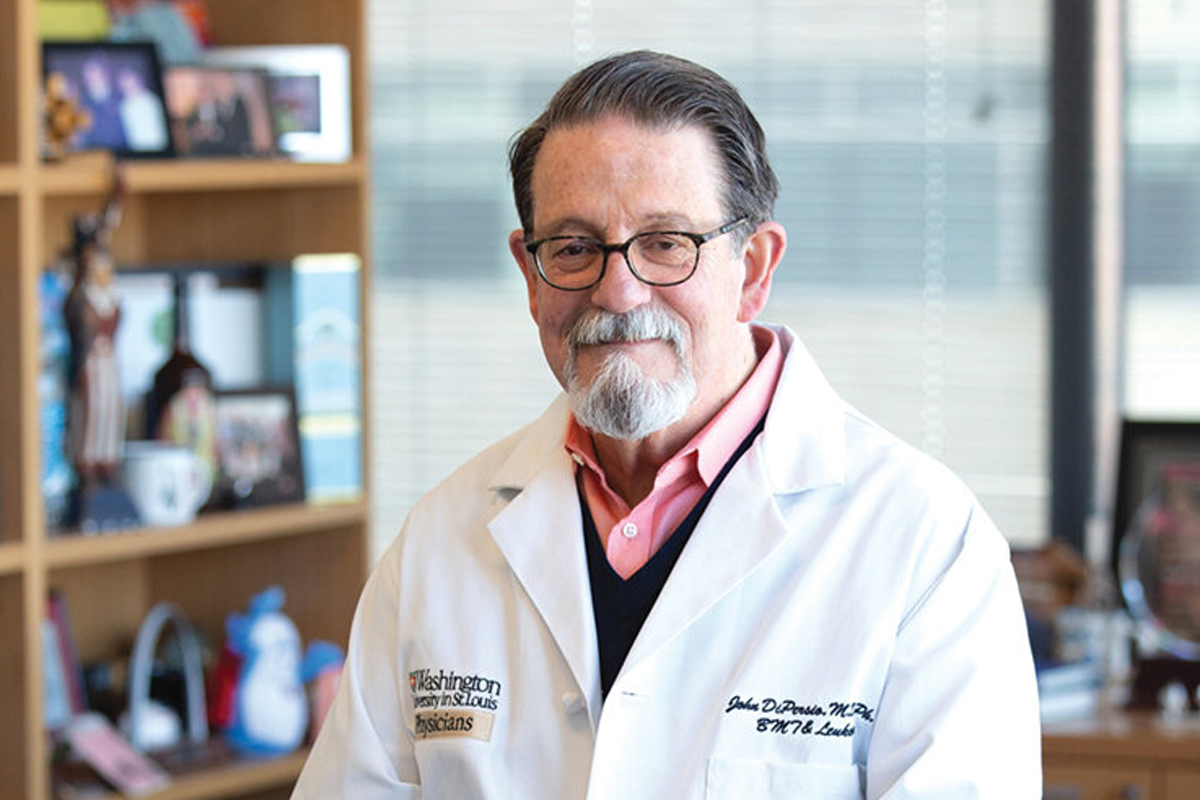
“The future of discovery depends on both good ideas and on the systems that allow those ideas to reach patients. We cannot lose sight of that responsibility.” Dr. DiPersio writes in this year’s welcome address.
It has been my privilege to serve as SOHO president for the 2025–2026 term. Despite the many challenges we face as clinicians and as a society, we can still take encouragement from the remarkable progress made in recent years to bring more effective therapies to patients with blood cancers.
In recent years, we have witnessed the emergence of entirely new classes of therapies, including next-generation immune engagers, CRISPR-engineered T cell and stem cell products, menin inhibitors, and CELMoDs. We are
moving beyond chemotherapy-alone approaches toward more rational, combination-based strategies. For the first time, clinicians are beginning to speak more seriously about the possibility of cure in diseases such as multiple myeloma in select patient populations, an idea that would have seemed out of reach not long ago.
These advances are translating into meaningful improvements in outcomes, with many of our patients living longer and most importantly with a better quality of life.
However, scientific progress is only one part of improving patient outcomes. We do not operate in a vacuum, and broader societal and structural pressures, from funding instability to barriers in clinical trial access, can significantly hinder biomedical advancement in the United States.
These past two years have been plagued with instability, whether perceived or real, as well as a lack of transparency. The current environment cannot be ignored by the field in which we practice. Turnover and turmoil within the institutions we rely on to advance science have had a significant effect on US global competitiveness due to brain drain and acute anxiety among international and early-career investigators. We cannot forget our mandate to drive the science internationally and not follow the lead of others.
Clinical research is facing a moment of real pressure. Across institutions, investigators continue to see trials become more expensive and entangled in bureaucracy, causing slower patient enrollment. Sponsored studies are often weighed down by regulatory demands and contract research organization-driven processes that consume valuable time and resources. At the same time, investigator-initiated trials are increasingly difficult to launch, even when there is a strong scientific rationale, an available drug, and a well-developed protocol. Finally, the reduced enthusiasm of biotech and big pharma to support institutional investigator-initiated trials coupled with decreased investment from the private sector for the support of startups from academic labs has created a very challenging environment for continued progress.
These challenges directly affect patients. When studies are delayed, underfunded, or unable to open or when ideas cannot be supported or translated into the clinic, patients lose access to potential therapies, and the field loses opportunities to answer important questions. Public funding constraints, private-sector uncertainty, and institutional cost pressures are converging in ways that make discovery harder, not easier.
As a biomedical community, we also need a stronger, more unified voice. Clinicians and scientists understand these problems because they live them every day, but we have not always communicated them
clearly to stakeholders and policymakers. If we want collaborative science to move forward, we must be willing to explain why efficient, adequately supported clinical research and productive public-private collaborations matter.
The future of discovery depends on both good ideas and the systems that allow those ideas to reach patients. We cannot lose sight of that responsibility.
John F. DiPersio, MD, PhD, is the President of the Society of Hematologic Oncology, and chief of the Division of Oncology at Washington University School of Medicine in St. Louis, Missouri.

Leave feedback about this