


The first- and second-generation immunomodulatory drugs (IMiDs) have fundamentally transformed the treatment landscape of multiple myeloma (MM) over the past two decades. Lenalidomide combinations became an integral component of frontline regimens,1,2 maintenance,3 and relapsed disease therapy.4,5 Owing to the extensive use of lenalidomide as induction and maintenance therapy, a proportion of myeloma patients are “lenalidomide-refractory” at first relapse. In this patient population, pomalidomide multidrug regimens (with bortezomib,6 CD38 monoclonal antibodies7,8) had proven efficacy in relapsed and refractory disease, but ultimately most patients relapse. This therapeutic evolution has exposed an important unmet need: a viable oral option with proven mechanistic advantage to overcome mechanisms of IMiD resistance.
CELMoDs represent the next generation of cereblon-binding agents specifically designed to address this challenge. Iberdomide and mezigdomide have demonstrated encouraging activity in heavily pretreated and IMiD-refractory MM that led to their evaluation in the maintenance and frontline settings.
Similar to IMiDs, CELMoDs pursue CRBN as their molecular target.9,10 Both iberdomide and mezigdomide bind CRBN with greater affinity compared with lenalidomide or pomalidomide and induce a conformational change from open to closed conformation, that promotes more efficient recruitment of the transcription factors IKZF1 and IKZF3 to the CRBN-E3 ubiquitin ligase complex.11,12 This results in accelerated ubiquitination and proteasomal degradation of these critical transcription factors, leading to suppression of IRF4 and MYC signaling, apoptosis of malignant plasma cells by direct tumoricidal effects (a differentiating feature from IMiDs), and enhanced immune cell activation through increased IL-2 production and T- and NK-cell stimulation.13,14 Compared with currently approved IMiDs, CELMoDs induce more rapid, deeper, and sustained degradation of IKZF1 and IKZF3, translating into superior antitumor activity in preclinical models and retained efficacy in models resistant to lenalidomide and pomalidomide.
Importantly, the enhanced immunologic effects of CELMoDs may have further implications in the current era of immunotherapy in myeloma. By restoring T-cell fitness, reducing immune exhaustion, and augmenting cytokine production, both iberdomide and mezigdomide may provide an ideal orally available partner for immune-based therapies such as bispecific antibodies and as priming prior to CAR T-cell therapies or as maintenance after.15
Clinical Development of Iberdomide
The initial first-in-human phase 2/3 CC-220-MM-001 trial as a single agent (cohorts A and C) and in combination with dexamethasone (cohorts B, D, and I) demonstrated clinically meaningful responses despite a heavily refractory patient population.16 Responses were observed among patients whose disease was refractory to both lenalidomide and pomalidomide, confirming clinically that CELMoDs have the potential to overcome IMiD resistance. These encouraging findings prompted evaluation of iberdomide in multidrug combinations such as iberdomide combined with daratumumab and dexamethasone (cohort E),17 which exploits complementary immune mechanisms of myeloma apoptosis. While daratumumab induces antibody-dependent cellular cytotoxicity and immune-mediated plasma cell killing, iberdomide simultaneously enhances T- and NK-cell function, potentially enhancing antitumor activity.18 This provided the clinical rationale and identified the optimal dose for the phase 3 study EXCALIBER-RRMM among patients who had early relapse (one to two lines of therapy) for the primary endpoint of progression-free survival (PFS).19 The study evaluated iberdomide at doses of 1.0, 1.3, and 1.6 mg in stage 1, given orally on days one to 21 every 28 days; in stage two, the dose of iberdomide at 1.0 mg was recommended as the phase 3 dose in combination with standard daratumumab and dexamethasone. The control arm is daratumumab, bortezomib, and dexamethasone. The study completed enrollment, and a press release confirmed a statistically significant improvement in measurable residual disease (MRD) negativity rates, compared with the control arm, in a planned interim analysis of the MRD endpoint.20
Two other phase 3 studies, EXCALIBER-maintenance21 and GMMG-HD9/DSMM XVIII22, evaluated the benefit of iberdomide in the maintenance setting post-transplant. The control arm for EXCALIBER-maintenance was lenalidomide for the primary endpoint of PFS. The study completed enrollment and results are awaited. For GMMG-HD9/DSMM XVIII, the control arm was iberdomide and isatuximab, and the primary endpoint is MRD negativity at two years. Ongoing and recently completed phase 3 trials of iberdomide are summarized in Table 1. A cohort of 75 transplant-ineligible newly diagnosed MM patients were evaluated with iberdomide at doses of 1.0, 1.3, and 1.6 mg (25 patients at each dose level) combined with daratumumab and dexamethasone, showing an overall response rate of 100%. MRD negativity (threshold 10-5) among patients that have achieved very good partial response or better was close to 60% in both the 1.0 and 1.3 mg cohorts.23 Clinical development increasingly emphasizes that iberdomide is likely to provide its greatest benefit as an immune-enhancing backbone supporting other active anti-myeloma agents across multiple phases of the myeloma treatment continuum.
Clinical Development of Mezigdomide
Mezigdomide has emerged as the second-generation CELMoD, akin to pomalidomide as a second-generation IMiD. The first-in-human phase 1/2 CC-92480-MM-001 trial evaluated mezigdomide plus dexamethasone in heavily pretreated patients with relapsed or refractory MM who received a median of six prior lines of therapy. Among this population, median PFS of 4.4 months and median duration of response (DOR) of 7.6 months was reported. In patients with prior anti-BCMA therapy, a median DOR of 6.9 months and median PFS of 5.4 months suggested clinically meaningful responses.24
Encouraging early-phase results rapidly led to the evaluation of mezigdomide in combination regimens. Notably, in the CC-92480-MM-001 trial, 40% of patients had extramedullary disease, and mezigdomide plus dexamethasone had shown activity in this population.25 Mezigdomide in combination with proteasome inhibitors was found to be safe, tolerable, and had clinical activity.26,27 The combination of mezigdomide, carfilzomib, and dexamethasone (MezKd) demonstrated particularly impressive efficacy, suggesting synergistic cereblon-mediated protein degradation and proteasome inhibition, ultimately providing the foundation for the randomized phase 3 SUCCESSOR clinical program as outlined in Table 1.
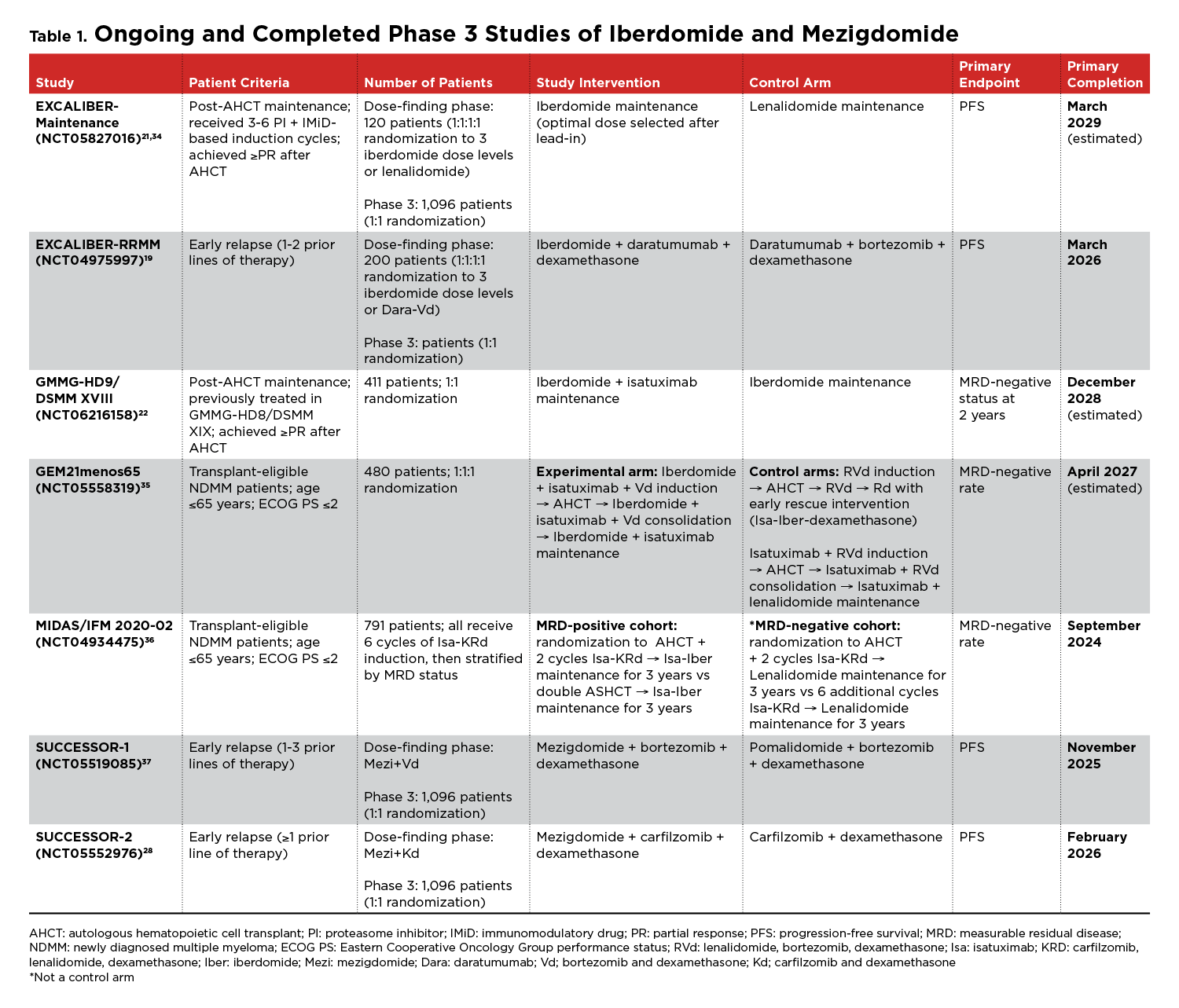
The SUCCESSOR-2 trial represents the first randomized phase 3 study to demonstrate a significant clinical benefit for a CELMoD in MM.28 Patients with relapsed or refractory MM were enrolled who had received at least one prior line of therapy and were exposed to both anti-CD38 monoclonal antibodies and lenalidomide. Median prior lines of therapy were two, more than three-quarters were lenalidomide refractory, and over 85% were refractory to anti-CD38 therapy. The trial compared MeziKd (with weekly carfilzomib) to standard carfilzomib and dexamethasone (Kd; twice weekly dosing) for the primary endpoint of PFS. After a median follow-up of 10.6 months, the median PFS for MeziKd versus Kd was 18.0 and 8.3 months (HR, 0.48; P<0.0001). MeziKd substantially deepened treatment responses. Rates of very good partial response or better and overall response rate with MeziKd were doubled and tripled, respectively, compared with Kd alone. A particularly noteworthy finding was the consistency of benefit across patients with high-risk cytogenetics, anti-CD38-refractory disease, and older adults.28 The FDA accepted new drug application for mezigdomide in patients with relapsed or refractory MM on July 13, 2026, based on results from SUCCESSOR-2 trial. The FDA has assigned a target action date of May 13, 2027, which likely will be the first CELMoD approval in the US.29
Safety
The toxicity profiles of CELMoDs differ in several important respects from those of lenalidomide and pomalidomide. Higher grades of neutropenia were typical of both iberdomide and mezigdomide, which has resulted in multiple dose exploratory studies in both the CC-220-MM-001 and CC-92480-MM-00124 trials. Grade 3/4 neutropenia exceeded 60% with mezigdomide-containing regimens, and the increased incidence of neutropenia is accompanied by a higher frequency of serious infections in the SUCCESSOR-2 trial.28 Grade ≥3 infections occurred in approximately one-third of patients receiving MezKd compared with 16% in the Kd arm. Appropriate antimicrobial usage when there is a suspicion for an infectious process and growth-factor support are highly encouraged.
Gastrointestinal toxicities such as diarrhea seem to be less common with CELMODs compared with IMiDs. Early clinical experience has not identified unexpected toxicities such as secondary primary malignancies despite prolonged administration, although long-term surveillance remains necessary. The VTE risk appears comparable to that of existing IMiDs, reinforcing the continued need for thromboprophylaxis based on established myeloma guidelines.30 The risk of fetal abnormalities among patients receiving CELMODs remains the same as IMiDs, likely stemming from pursuing the molecular target CRBN, and in future, one would expect dispensing through a REMS program.31 The optimal balance between hematologic toxicity and clinical efficacy is likely to be acceptable for patients with relapsed or refractory MM, particularly for those who are BCMA-refractory, and a potential active oral agent is promising. Although many patients achieve deep responses after CAR T-cell therapy, relapse remains common because of antigen escape, limited CAR persistence, and progressive immune dysfunction. CELMoDs may provide an effective immune-restorative strategy capable of prolonging remission after cellular therapy.15
Conclusions and Future Directions
CELMoDs induce direct tumor cytotoxicity and simultaneously enhance immune-mediated myeloma cell kill makes them attractive partners across virtually every stage of the disease continuum.12 Perhaps the most exciting future application is combination therapy with bispecific antibodies. Current BCMA- and GPRC5D-directed bispecific antibodies produce remarkable response rates but remain limited by T-cell exhaustion and diminishing immune function during prolonged treatment. Iberdomide and mezigdomide in combination with elranatamab have shown impressive activity in preliminary trials and can improve the durability of bispecific antibody responses.32,33 An equally promising application involves priming prior to CAR-T collection and as maintenance after CAR T-cell therapy.
CELMoDs could potentially maintain immune activation after CAR T-cell infusion, improve persistence of a subset of functional cytotoxic lymphocytes that potentially can offer ongoing myeloma control, and delay disease recurrence.15 Their oral administration makes them attractive as long-term maintenance therapy following cellular therapy similar to IMiDS. As safety experience accumulates, CELMoDs are likely to move progressively into frontline treatment. Replacing conventional IMiDs with CELMoDs during quadruplet induction therapies or consolidation may produce deeper responses, higher MRD-negativity rates, and more durable remissions. Similarly, CELMoDs also represent a logical evolution of maintenance therapy.34 Their greater potency and early clinical evidence raise the possibility of deeper MRD negativity rates.
Looking ahead, CELMoDs likely are ideal partners with other anti-myeloma agents in the newly diagnosed setting, as agents to attain MRD negativity in the maintenance setting, in combinations with bispecific antibodies, as priming agents for T cells prior to CAR T-cell therapy or as maintenance, and in the future with other immune-based combinations. Their integration into rational combination strategies has an extensive potential not only to extend survival but for “cure” in myeloma.
Ajay Nooka, MD, MPH, is a clinical member of the Cancer Prevention and Control Research Program at Winship Cancer Institute of Emory University.
References
- Sonneveld P, Dimopoulos MA, Boccadoro M, et al. Daratumumab, Bortezomib, Lenalidomide, and Dexamethasone for Multiple Myeloma. N Engl J Med. 2024;390(4):301-313. doi:10.1056/NEJMoa2312054
- Facon T, Dimopoulos MA, Leleu XP, et al. Isatuximab, Bortezomib, Lenalidomide, and Dexamethasone for Multiple Myeloma. N Engl J Med. 2024;391(17):1597-1609. doi:10.1056/NEJMoa2400712
- Attal M, Lauwers-Cances V, Marit G, et al. Lenalidomide maintenance after stem-cell transplantation for multiple myeloma. N Engl J Med. 2012;366(19):1782-1791. doi:10.1056/NEJMoa1114138
- Siegel DS, Dimopoulos MA, Ludwig H, et al. Improvement in Overall Survival With Carfilzomib, Lenalidomide, and Dexamethasone in Patients With Relapsed or Refractory Multiple Myeloma. J Clin Oncol. 2018;36(8):728-734. doi:10.1200/JCO.2017.76.5032
- Dimopoulos MA, Oriol A, Nahi H, et al. Overall Survival With Daratumumab, Lenalidomide, and Dexamethasone in Previously Treated Multiple Myeloma (POLLUX): A Randomized, Open-Label, Phase III Trial. J Clin Oncol. 2023;41(8):1590-1599. doi:10.1200/JCO.22.00940
- Richardson P, Beksaç M, Oriol A, et al. Pomalidomide, Bortezomib, and Dexamethasone Versus Bortezomib and Dexamethasone in Relapsed or Refractory Multiple Myeloma: Final Survival and Subgroup Analyses From the OPTIMISMM Trial. Eur J Haematol. 2025;114(5):822-831. doi:10.1111/ejh.14365
- Dimopoulos MA, Terpos E, Boccadoro M, et al. Daratumumab plus pomalidomide and dexamethasone versus pomalidomide and dexamethasone alone in previously treated multiple myeloma (APOLLO): an open-label, randomised, phase 3 trial. Lancet Oncol. 2021;22(6):801-812. doi:10.1016/S1470-2045(21)00128-5
- Martin T, Dimopoulos MA, Mikhael J, et al. Correction: Isatuximab, carfilzomib, and dexamethasone in patients with relapsed multiple myeloma: updated results from IKEMA, a randomized Phase 3 study. Blood Cancer J. 2023;13(1):152. Published 2023 Sep 27. doi:10.1038/s41408-023-00923-6
- Bird S, Pawlyn C. IMiD resistance in multiple myeloma: current understanding of the underpinning biology and clinical impact. Blood. 2023;142(2):131-140. doi:10.1182/blood.2023019637
- Zhu YX, Braggio E, Shi CX, et al. Identification of cereblon-binding proteins and relationship with response and survival after IMiDs in multiple myeloma. Blood. 2014;124(4):536-545. doi:10.1182/blood-2014-02-557819
- Watson ER, Novick S, Matyskiela ME, et al. Molecular glue CELMoD compounds are regulators of cereblon conformation. Science. 2022;378(6619):549-553. doi:10.1126/science.add7574
- Gao S, Wang S, Song Y. Novel immunomodulatory drugs and neo-substrates. Biomark Res. 2020;8:2. Published 2020 Jan 9. doi:10.1186/s40364-020-0182-y
- Matyskiela ME, Zhang W, Man HW, et al. A Cereblon Modulator (CC-220) with Improved Degradation of Ikaros and Aiolos. J Med Chem. 2018;61(2):535-542. doi:10.1021/acs.jmedchem.6b01921
- Hansen JD, Correa M, Nagy MA, et al. Discovery of CRBN E3 Ligase Modulator CC-92480 for the Treatment of Relapsed and Refractory Multiple Myeloma. J Med Chem. 2020;63(13):6648-6676. doi:10.1021/acs.jmedchem.9b01928
- Van Oekelen O, Amatangelo M, Guo M, et al. Iberdomide increases innate and adaptive immune cell subsets in the bone marrow of patients with relapsed/refractory multiple myeloma. Cell Rep Med. 2024;5(6):101584. doi:10.1016/j.xcrm.2024.101584
- Lonial S, Popat R, Hulin C, et al. Iberdomide plus dexamethasone in heavily pretreated late-line relapsed or refractory multiple myeloma (CC-220-MM-001): a multicentre, multicohort, open-label, phase 1/2 trial. Lancet Haematol. 2022;9(11):e822-e832. doi:10.1016/S2352-3026(22)00290-3
- Balarí AS, Khan A, Oriol A, et al. Iberdomide plus daratumumab and dexamethasone (IberDd) in patients with newly diagnosed multiple myeloma by renal function: A subgroup analysis of the CC-220-MM-001 trial. Blood. 2025;146(Supplement 1):5810. doi:10.1182/blood-2025-5810
- Ma P, Sridharan V, Wollerman K, et al. Iberdomide Enhances Dara Mediated Cytotoxicity through Upregulation of CDC Activity and Elevated NK Cell Mediated ADCC. Blood. 2023;142(Supplement 1):3289. doi:10.1182/blood-2023-189423
- Lonial S, Dimopoulos MA, Berdeja JG, et al. EXCALIBER-RRMM: a phase III trial of iberdomide, daratumumab, and dexamethasone in relapsed/refractory multiple myeloma. Future Oncol. 2025;21(14):1761-1769. doi:10.1080/14796694.2025.2501920
- Dana-Farber Cancer Institute. First FDA approval of CAR T-cell therapy for multiple myeloma marks milestone for patients. Dana-Farber Cancer Institute. Published March 27, 2021. Accessed January 13, 2025. https://www.dana-farber.org/newsroom/news-releases/2021/first-fda-approval-of-car-t-cell-therapy-for-multiple-myeloma-marks-milestone-for-patients
- ClinicalTrials.gov. A phase 3, two-stage, randomized, multi-center, controlled, open-label study comparing iberdomide maintenance to lenalidomide maintenance therapy after autologous stem cell transplantation (ASCT) in participants with newly diagnosed multiple myeloma (NDMM) (EXCALIBER-Maintenance). ClinicalTrials.gov Identifier: NCT05827016. Accessed July 23, 2026. https://clinicaltrials.gov/study/NCT05827016
- ClinicalTrials.gov. A randomized phase III trial assessing iberdomide versus iberdomide plus isatuximab maintenance therapy post autologous hematopoietic stem cell transplantation in patients with newly diagnosed multiple myeloma (GMMG-HD9/DSMM XVIII). ClinicalTrials.gov Identifier: NCT06216158. Sponsor: University of Heidelberg Medical Center. Status: Recruiting. Accessed July 23, 2026. https://clinicaltrials.gov/study/NCT06216158
- Amatangelo M, Stong N, Maciag P, et al. Iberdomide, Daratumumab, and Dexamethasone Shows Deep Antimyeloma Activity across Molecular Patient Subsets with Transplant-Ineligible Newly Diagnosed Multiple Myeloma from the CC-220-MM-001 Trial. Blood. 2024;144(Supplement 1):1973. doi:10.1182/blood-2024-199016
- Richardson PG, Trudel S, Popat R, et al. Mezigdomide plus Dexamethasone in Relapsed and Refractory Multiple Myeloma. N Engl J Med. 2023;389(11):1009-1022. doi:10.1056/NEJMoa2303194
- Richardson PG, Vangsted AJ, Ramasamy K, et al. First-in-human phase I study of the novel CELMoD agent CC-92480 combined with dexamethasone (DEX) in patients (pts) with relapsed/refractory multiple myeloma (RRMM). Journal of Clinical Oncology. 2020;38(15_suppl):8500. doi:10.1200/jco.2020.38.15_suppl.8500
- Oriol A, Sandhu I, Raab M, et al. OA-49 Mezigdomide (MEZI) plus dexamethasone (DEX) and bortezomib (BORT) or carfilzomib (CFZ) in patients (pts) with relapsed/refractory multiple myeloma (RRMM): results from the CC-92480-MM-002 trial. Clinical Lymphoma Myeloma & Leukemia. 2023;23:S31. doi:10.1016/s2152-2650(23)01616-6
- Sandhu I, Richardson PG, Oriol A, et al. Mezigdomide (MEZI) Plus Dexamethasone (DEX) and Bortezomib (BORT) or Carfilzomib (CFZ) in Patients (pts) with Relapsed/Refractory Multiple Myeloma (RRMM): Updated Results from the CC-92480-MM-002 Trial. Blood. 2024;144(Supplement 1):1025. doi:10.1182/blood-2024-198408
- Dimopoulos MA, Schjesvold F, Fu C, et al. Mezigdomide, carfilzomib, and dexamethasone versus carfilzomib and dexamethasone in patients with relapsed or refractory multiple myeloma (SUCCESSOR-2): a phase 3, open-label, randomised controlled trial. Lancet. 2026;408(10551):219-233. doi:10.1016/S0140-6736(26)01088-3
- Bristol Myers Squibb. U.S. Food and Drug Administration accepts Bristol Myers Squibb’s New Drug Application for mezigdomide in patients with relapsed or refractory multiple myeloma. Bristol Myers Squibb. Published July 13, 2026. Accessed July 23, 2026. https://news.bms.com/news/corporate-financial/2026/U-S–Food-and-Drug-Administration-Accepts-Bristol-Myers-Squibbs-New-Drug-Application-for-Mezigdomide-in-Patients-with-Relapsed-or-Refractory-Multiple-Myeloma/default.aspx
- Palumbo A, Rajkumar SV, Dimopoulos MA, et al. Prevention of thalidomide- and lenalidomide-associated thrombosis in myeloma. Leukemia. 2008;22(2):414-423. doi:10.1038/sj.leu.2405062
- Bristol Myers Squibb. REMS prescriber portal. Bristol Myers Squibb. Accessed July 23, 2026. https://bmsremspatientsafety.com/
- Suvannasankha A, Kaufman J, Badros A, et al. Safety and efficacy of elranatamab in combination with iberdomide in patients with relapsed or refractory multiple myeloma: Results from the phase 1b MagnetisMM-30 trial. Blood. 2025;146(Supplement 1):100. doi:10.1182/blood-2025-100
- Byun JM, Min CK, Kim K, et al. Phase I/II study of mezigdomide and elranatamab for relapsed/refractory multiple myeloma patients (MELT-MM): Initial results from part 1. Blood. 2025;146(Supplement 1):5835. doi:10.1182/blood-2025-5835
- Van De Donk NWCJ, Touzeau C, Terpos E, et al. Iberdomide maintenance after autologous stem-cell transplantation in newly diagnosed multiple myeloma: An update from the phase 2 EMN26 trial. Blood. 2025;146(Supplement 1):101. doi:10.1182/blood-2025-101
- ClinicalTrials.gov. Comparing bortezomib, lenalidomide, and dexamethasone (VRD) extended plus autologous stem cell transplantation (ASCT), isatuximab-VRD plus ASCT, and isatuximab-VRD-iberdomide plus ASCT in transplant-eligible newly diagnosed multiple myeloma (GEM21menos65). ClinicalTrials.gov Identifier: NCT05558319. Accessed July 23, 2026. https://clinicaltrials.gov/study/NCT05558319
- Perrot A, Hulin C, Lambert J, et al. MRD-driven strategy following IsaKRD induction in transplant-eligible NDMM: Primary endpoints of the phase 3 MIDAS trial. Journal of Clinical Oncology. 2025;43(16_suppl):7500. doi:10.1200/jco.2025.43.16_suppl.7500
- Richardson PG, Badelita SN, Besemer B, et al. MM-372 A Phase III, Two-Stage, randomized study of mezigdomide, bortezomib, and Dexamethasone (MEZIVD) versus pomalidomide, bortezomib, and Dexamethasone (PVD) In Relapsed/Refractory Multiple Myeloma (RRMM): SUCCESSOR-1. Clinical Lymphoma Myeloma & Leukemia. 2023;23:S495-S496. doi:10.1016/s2152-2650(23)01446-5


Leave feedback about this