

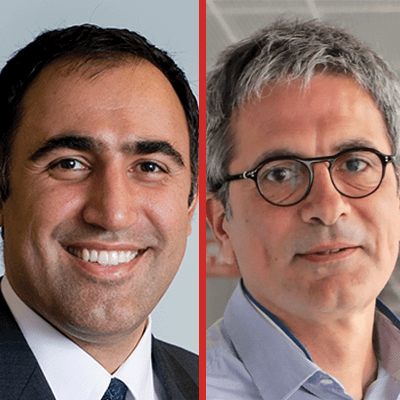
Drs. Fathi and Recher debate the topic at 4:50 pm CST on September 9.
Drs. Amir Fathi and Christain Recher face off on the debate stage to discuss the appropriate treatment for younger fit patients with acute myeloid leukemia (AML). Read on for a preview of their positions and catch the pair live during their session this afternoon.
PRO: Amir Fathi, MD
Massachusetts General Hospital
The upfront treatment for many functionally fit adults with AML may be evolving toward the use of lower-intensity, better-tolerated regimens. For more than five decades, intensive induction chemotherapy (IC) has been the established upfront approach for the fit AML patient. However, long-term outcomes remain poor for most, and the associated toxicity and morbidity with IC are substantial.
The success of combinations using hypomethylating agents and venetoclax (HMA-Ven) among older patients has highlighted the possibility of effective therapy for AML, while minimizing associated toxicity. In recent years, multiple retrospective studies have compared the use of traditional IC regimens with HMA-Ven among them, although these have been impacted by the natural limitations and biases of retrospective designs.
More recently, prospective trials, including randomized comparative studies such as PARADIGM, have demonstrated that HMA-Ven can be a more effective and better-tolerated upfront therapeutic approach and bridge to transplant compared with IC among select fit patients with AML. However, it is important to note that certain patient populations were excluded by eligibility from PARADIGM, such as younger patients with favorable-risk disease or those with FLT3 mutations. For these patients, future trials that incorporate relevant targeted therapies into HMA-Ven regimens are required to support the use of gentler, more targeted upfront approaches.
CON: Christian Recher, MD, PhD
University of Toulouse, France
For over 40 years, IC—the “7+3” combination of cytarabine and an anthracycline as induction, followed by intermediate- to high-dose cytarabine consolidation and, when indicated, allogeneic transplantation—has remained the backbone of curative treatment for younger fit patients with AML. Despite criticism of its toxicity, IC still cures a substantial proportion of patients within a fixed treatment duration, with or without transplant in first complete remission (CR).
Far from becoming obsolete, IC is now entering its most promising era. Recent research has focused not on abandoning the chemotherapy backbone but on enriching it: the RATIFY and QUANTUM-First trials established midostaurin and quizartinib as standards of care for FLT3-mutated AML, each demonstrating a clear overall survival benefit when added to IC.
This is only the beginning. Pivotal trials combining IC with IDH1, IDH2, menin-KMT2A, or BCL-2 inhibitors are due to report shortly, and early phase 1 data with ivosidenib, enasidenib, venetoclax, and menin inhibitors already show excellent feasibility, safety, high CR rates, and rapid measurable residual disease clearance. In other words, rather than being replaced, standard IC is set to diversify into a family of molecularly tailored standards—one backbone, multiple targeted combinations—leaving only a handful of very-high-risk subgroups, such as TP53-mutated or MECOM-rearranged AML, without a truly effective option. Against this backdrop, the case for low-intensity therapy in younger adults remains, at best, premature. The available data are simply not mature or robust enough to justify a departure from intensive treatment in this population today.



Leave feedback about this