

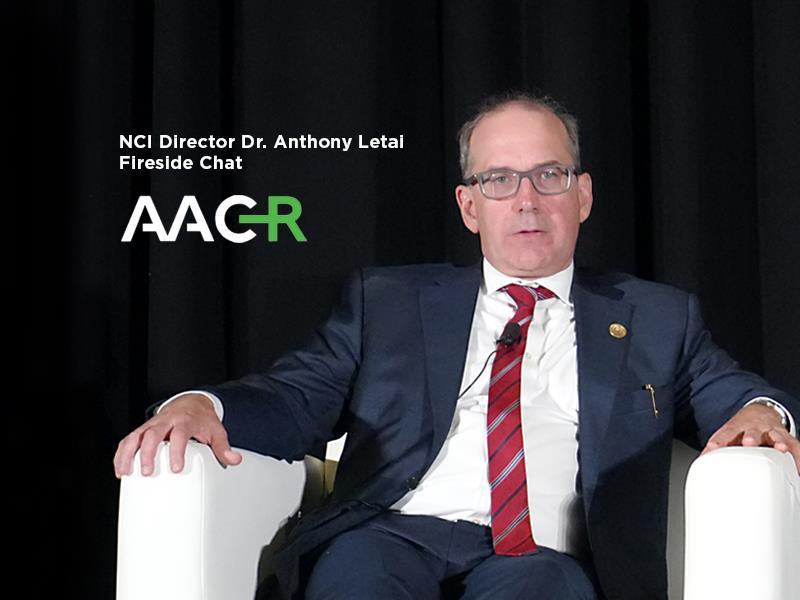
During a session at AACR 2026, NCI Director Anthony Letai, MD, PhD, said that despite a turbulent past year, the institute is stable and its mission unchanged.
“This past year… [has] been very turbulent,” Dr. Letai said. “But let me reiterate to you: The NCI is stable. Our mission remains unchanged and funding is strong.”
The sources of that turbulence were not directly addressed, even as recent reporting has pointed to funding instability, workforce disruption, and early signs of a potential brain drain in US science. Reported funding cuts to NIH grants linked to the Department of Government Efficiency (DOGE), a cost-cutting unit associated with Elon Musk, have been tied to disruptions across the research ecosystem, including reported clinical trial disruptions and workforce instability.
“I really do see stability going forward,” Dr. Letai said. “I’ve had the opportunity to talk fairly regularly with the president and the secretary and to legislators on both sides of the aisle in both houses of Congress, and they just want us to cure cancer,” he said. “People want to support cancer research because it’s politically the right thing to do. It’s so overwhelmingly popular. And I hear the same thing from the executive branch.”
For fiscal year 2026, the NCI saw a $128 million increase after Congress rejected deeper proposed cuts. The NCI is funded at approximately $7.3 billion in 2026.
Given that, Dr. Letai cautioned against “doom and gloom” and urged researchers to rely on “sources that reflect the truth.”
“I want to remind you, the only budget that really counts is the budget that is approved by Congress and signed by the president,” he said.
However, he did note Congress has not shown strong enthusiasm for expanding multiyear funding, a development that has raised concerns in terms of its impact on the number of research awards allocated to investigators.
“I do not see enthusiasm in Congress for continuing increasing multiyear funding,” he said, adding that underlying funding constraints mean that “that baseline might not be what you wish it was” and “we can’t fund all the grants.”
One area of focus for the NCI will be to ensure continued US competitiveness in biomedical research, Dr. Letai said.
He described global competition as a “wake-up call,” noting that “the United States is no longer the world’s only engine of biomedical innovation.” He pointed to faster trial activation overseas and acknowledged that “it takes too long in this country to move from a promising idea to testing in patients,” adding that some processes “could be done in parallel… and maybe move much faster.”
He pointed to Australia as a good model for the United States to follow for clinical trial administration and noted that the FDA is starting to roll out initiatives to help with efficiency.
“While we can’t duplicate the Australian approach … [we can] imitate some of things they have done to have made them faster,” he said.
Another area of focus is the NCI’s functional precision medicine initiative. The approach is part of a larger NIH initiative to move away from animal models in cases where human tissue testing is considered an optimal alternative.
“If you want to know whether a drug will work on a patient’s tumor, take that living tumor tissue, expose it to the drug, and observe what happens,” rather than “inferring whether a treatment will work based on… model systems,” he said.
He also said that in July 2025 the NCI will be announcing a workshop to support these efforts in functional precision medicine.
“All of us here share a common goal: to reduce suffering from cancer,” he said. “We have made enormous progress to the goal in the last 35 years.”




Leave feedback about this